What Is Opus 4.6?
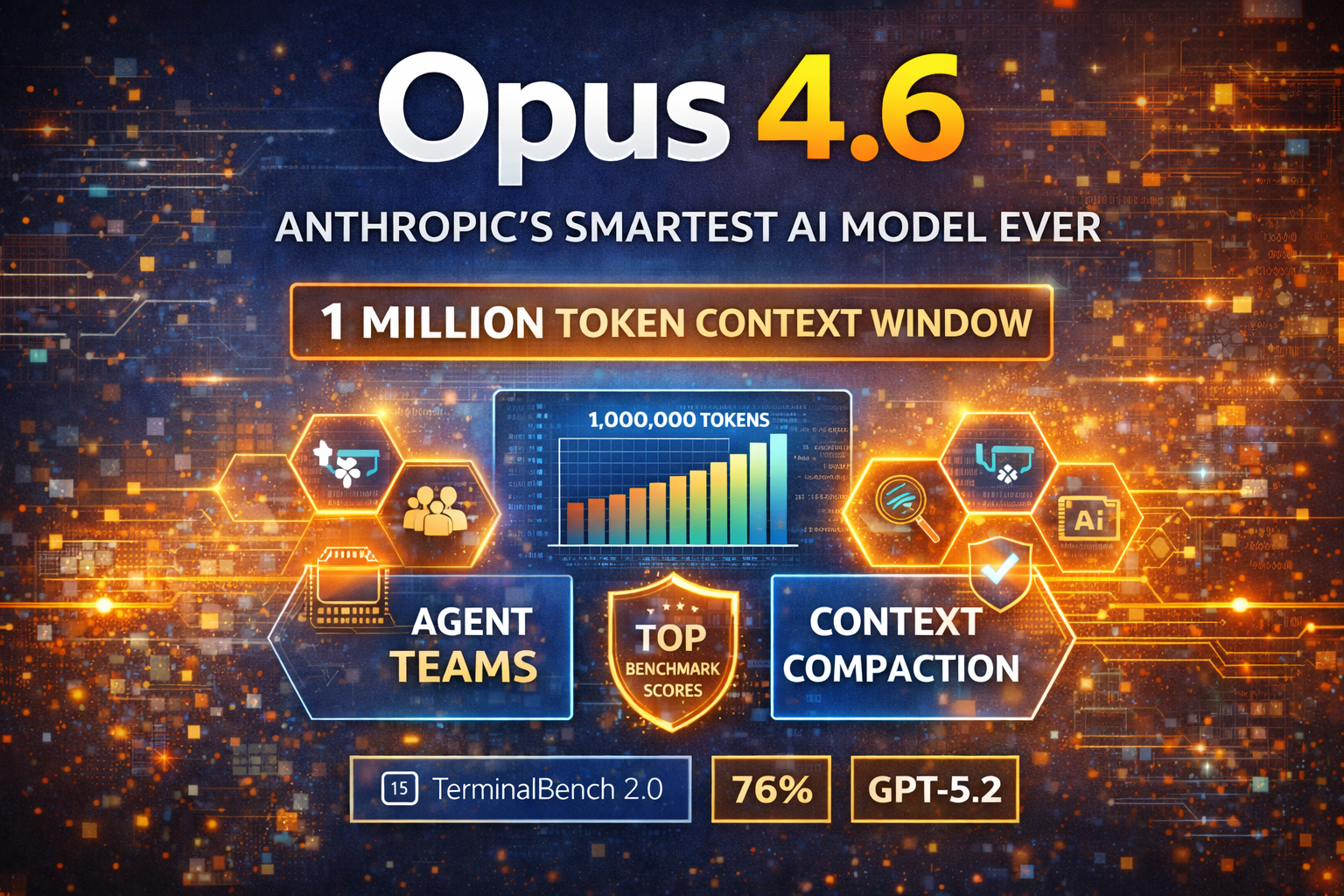
Opus 4.6 is the latest flagship AI model released by Anthropic, designed to push the boundaries of what large language models can do. Unlike earlier models that mainly answered questions or completed short tasks, Opus 4.6 can handle sustained, complex, agentic workflows like navigating massive codebases, performing detailed financial analyses, and self‑debugging — all without losing context midway.
This model represents a significant evolution in AI capability, combining massive context understanding with powerful autonomous task execution.
1 Million Token Context Window
One of the standout upgrades in Opus 4.6 is its 1 million token context window — a capability that allows the AI to keep track of extremely long documents, large code projects, or extended back‑and‑forth conversations without forgetting earlier information. Most previous models struggled once they went beyond a fraction of this size, which often made tool‑assisted workflows disjointed.
In practical terms, this means Opus 4.6 can work on long legal briefs, research papers, or massive software repositories without losing track of earlier parts of the text. On the MRC2 Sonnet 42 benchmark, Anthropic reports that Opus 4.6 achieved roughly 76% accuracy at retrieving information across the full million-token span—a massive leap compared to older models, which scored under 20%. For more details, visit Anthropic’s official page.
Agent Teams: Multiple Agents Working Together
Another major innovation in Opus 4.6 is the introduction of Agent Teams in Claude Code. Instead of operating as a single AI instance processing steps one after another, Opus 4.6 can spin up multiple AI agents at once. These agents collaborate in parallel, independently tackling different parts of a complex task and coordinating with each other to complete it faster and more efficiently.
This multi‑agent system is particularly useful in engineering workflows, where different parts of a codebase or different subtasks benefit from simultaneous handling. For example, while one agent reviews backend code, another can analyze frontend modules, and yet another can test performance—all at the same time.
Context Compaction Keeps Long Tasks Running
Even with a huge context window, extremely long conversations or tasks could hit limits in older models. Opus 4.6 tackles this with Context Compaction, a system that automatically summarizes older parts of a conversation while keeping the essential meaning intact. This lets agent‑based workflows continue for extended periods without hitting memory limits or losing critical earlier details.
This innovation means that projects like multi‑session debugging, ongoing research conversations, or multi‑step financial analysis can proceed smoothly in a single session, rather than needing to break up the context manually.
Improved Benchmarks and Performance
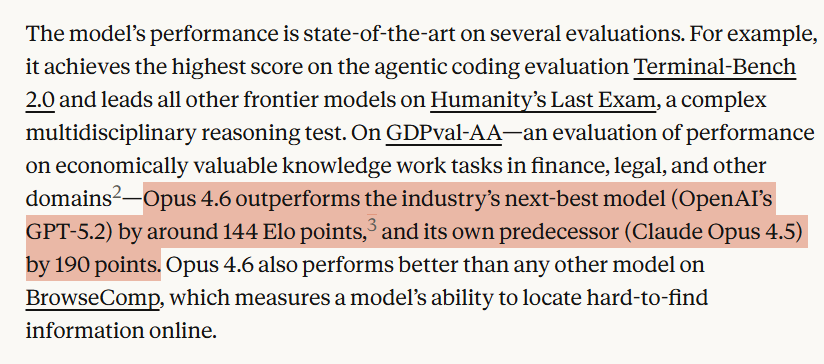
On key tests, Opus 4.6 outperforms many of its predecessors and competitors. For example, on the Terminal‑Bench 2.0 benchmark, which measures agentic coding performance, Opus 4.6 achieved one of the highest scores yet recorded.
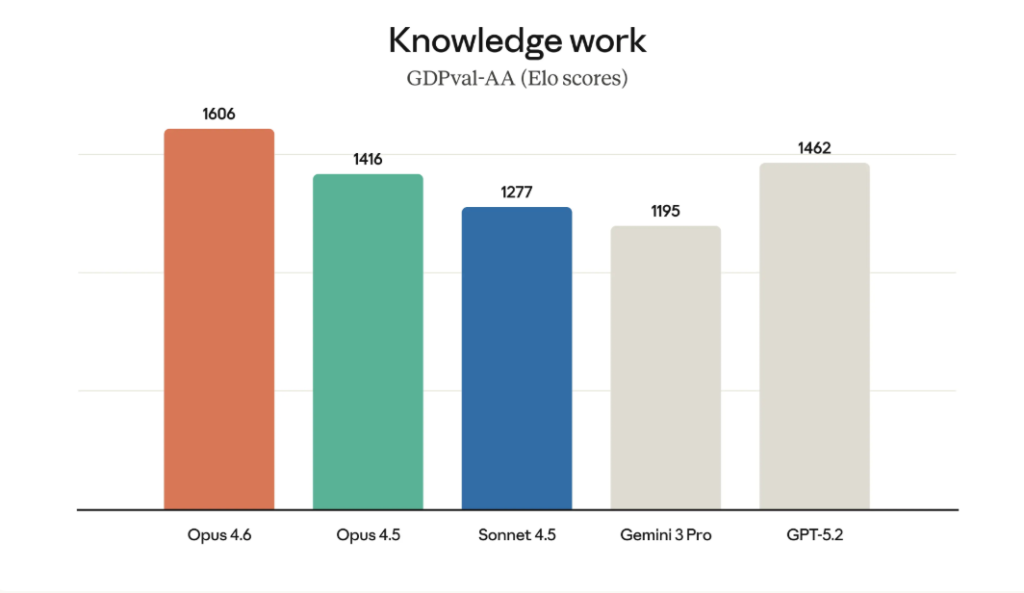
Additionally, in real‑world knowledge work evaluations that test reasoning, multi‑discipline tasks, and detailed information retrieval, Opus 4.6 consistently leads performance charts and even beats models like GPT‑5.2 in certain evaluations. These results show that the model isn’t just bigger, it’s smarter and more capable across a wide variety of complex problem types.
Adaptive Thinking and Effort Controls
Rather than applying a one‑size‑fits‑all approach to reasoning depth, Opus 4.6 uses adaptive thinking — a system that dynamically adjusts how much reasoning the model uses based on task complexity. Simple tasks get quick, efficient responses; complex tasks activate deeper reasoning. This leads to better efficiency and quality without forcing developers to tune parameters manually.
Where Opus 4.6 Is Available
Opus 4.6 is already accessible through Anthropic’s main Claude platform, the Claude API, and on major cloud platforms such as AWS Bedrock and Google Cloud’s Vertex AI. Developers and enterprises looking to build powerful AI‑assisted tools, long‑form reasoning systems, or sophisticated coding automation can integrate Opus 4.6 to support advanced workflows.
What This Means for AI Development
The release of Opus 4.6 shows that the frontier of AI isn’t just about answering queries or generating text — it’s about sustaining long, complex tasks and operating in environments that require deep contextual understanding and autonomous coordination.
The era where models struggled to remember information after a few thousand words is rapidly ending. With innovations like multi‑agent collaboration and context compaction, AI is becoming a true partner for complex workflows.
To stay updated on the latest in AI model advancements, check out our AI Technology Updates.
Have feedback or questions about this article?
You can reach us at contact.techorai@gmail.com