ChatGPT Ads are being introduced by OpenAI as part of a new monetization strategy, and this announcement has triggered widespread discussion across the tech community. Many users immediately questioned whether advertising would affect ChatGPT’s answers, compromise privacy, or turn the AI into a product-promotion platform. While online discussions often exaggerated the risks, the actual implementation of ChatGPT Ads is far more controlled and transparent.
OpenAI’s goal is not to change how ChatGPT works, but to ensure the long-term sustainability of the free version while maintaining trust.
Why OpenAI Is Introducing ChatGPT Ads
ChatGPT operates on massive computational infrastructure that requires constant investment. Millions of users rely on ChatGPT daily, but only a small percentage subscribe to paid plans. Introducing ChatGPT Ads allows OpenAI to support free access without significantly increasing subscription prices for paid users.
This approach follows a familiar internet model: free access supported by advertising, while premium users enjoy an ad-free experience. OpenAI has chosen this route to balance accessibility with financial sustainability.
ChatGPT Ads will only appear for users on the Free plan and the ChatGPT Go plan. Users subscribed to Plus, Pro, Business, Enterprise, and Education plans will not see any ads at all. OpenAI has also confirmed that users under the age of 18 will be excluded from advertising entirely.
This ensures that professional, enterprise, and educational environments remain clean, private, and distraction-free.
Where ChatGPT Ads Will Appear
One of the most important assurances from OpenAI is that ChatGPT Ads will not appear inside AI-generated answers. Responses will remain unbiased, accurate, and independent.
Ads will be displayed separately, clearly labeled as “Sponsored” or “Ad,” and visually distinct from ChatGPT responses. This separation ensures transparency and prevents confusion between helpful information and advertising content.

OpenAI has explicitly stated that ChatGPT Ads do not influence how answers are generated. The system produces responses based on usefulness and accuracy first. Advertising is added only after the response is completed.
Advertisers cannot pay to influence recommendations, rankings, or reasoning. This design choice protects the integrity of ChatGPT and ensures that the AI remains a reliable source of information rather than a marketing tool.
ChatGPT Ads and User Privacy
Privacy is one of the biggest concerns surrounding ChatGPT Ads. OpenAI has made it clear that it does not sell user data to advertisers. Chat history, prompts, personal information, stored memory, and uploaded files are never shared.
Advertisers only receive anonymized, aggregated metrics such as impressions and clicks. No personal conversations or identities are exposed. Users also have control over ad personalization settings, allowing them to manage how ads are shown.
For official details, OpenAI explains its privacy stance here: OpenAI Privacy Policy
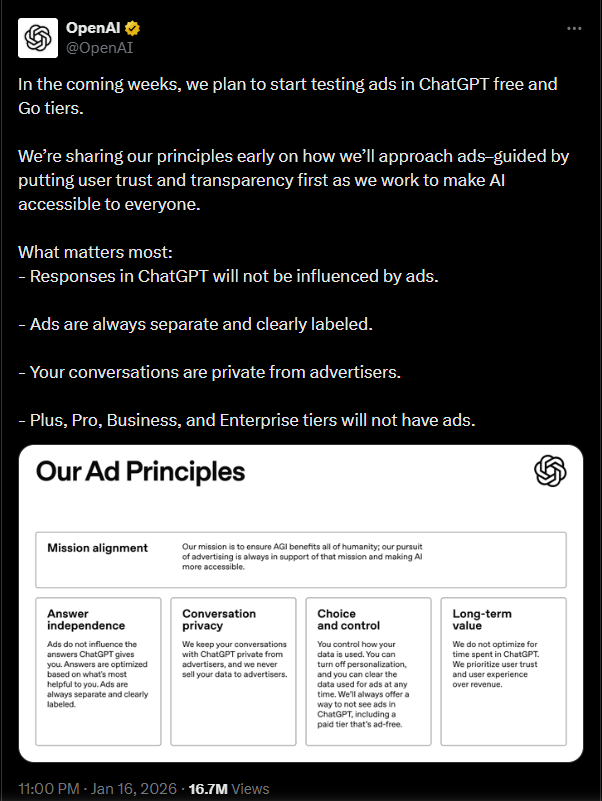
ChatGPT Ads are primarily based on the current conversation context, not long-term personal profiling. If a user is discussing technology, they may see a related ad, but sensitive topics such as health, mental health, politics, and personal crises are excluded entirely. This approach helps maintain relevance without crossing ethical or privacy boundaries.
At the moment, ChatGPT Ads are being tested on a limited scale in the United States. There is no confirmed timeline for a global rollout. OpenAI has stated that this cautious approach allows time to refine safeguards, improve transparency, and gather user feedback before expanding.
Final Thoughts on ChatGPT Ads
ChatGPT Ads represent a careful attempt to balance innovation, trust, and financial sustainability. Free users continue to access ChatGPT without cost, paid users remain completely ad-free, and OpenAI gains a revenue stream to support future development.
As long as ads stay outside AI responses and privacy commitments are respected, ChatGPT Ads are unlikely to disrupt the core user experience. The long-term success of this approach will depend on transparency, strong user controls, and responsible expansion.
If you’re interested in similar updates, you can explore more insights in our Tech News section.
Have feedback or questions about this article?
You can reach us at contact.techorai@gmail.com